What Happens to Your 401(k) in a Divorce?
Your 401(k) is likely one of your largest assets. Here's how retirement accounts are divided in divorce, what a QDRO is, and how to avoid the tax traps that catch people off guard.
By IncoVoid Editorial Team
For most working Americans, a 401(k) or similar retirement account is one of the most significant assets they own. In a divorce, it is also one of the most commonly mishandled. People either assume it is protected or assume it will be split automatically. Neither is quite right.
Here is what actually happens.
Is Your 401(k) Marital Property?
Whether any part of your 401(k) is subject to division depends on when the contributions were made.
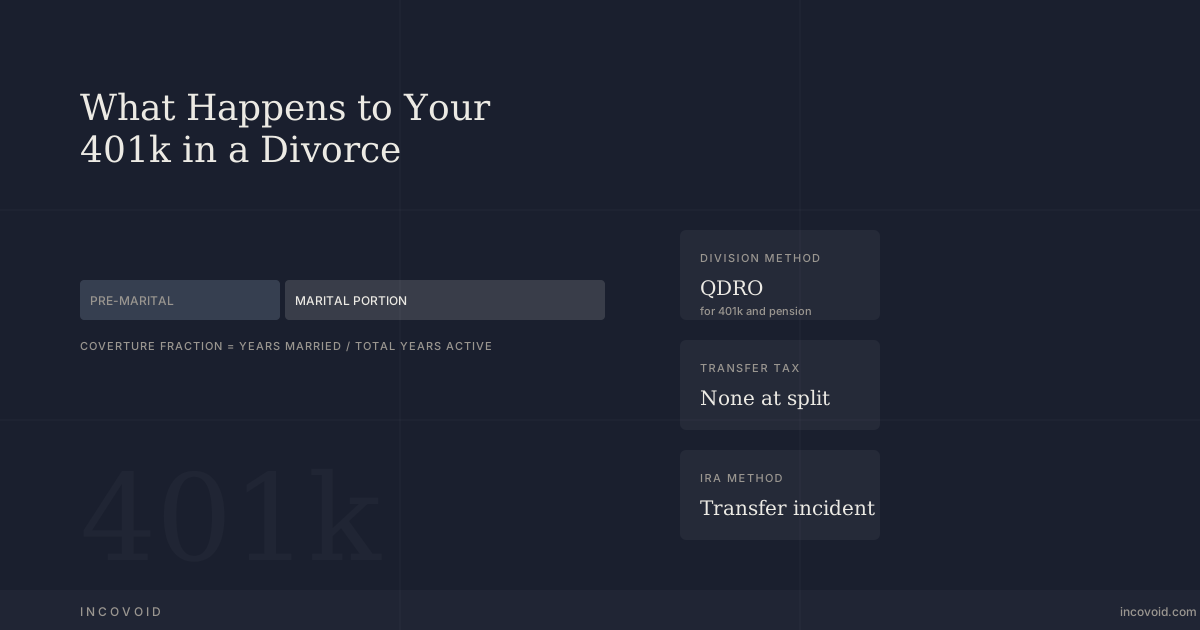
Contributions made before the marriage are generally considered separate property. They belong to you alone and are typically not subject to division.
Contributions made during the marriage are generally marital property, regardless of whose name is on the account. This is true whether you are in a community property state or an equitable distribution state. The logic is straightforward: contributions during the marriage came from marital income, which both spouses have a stake in.
If you have a 401(k) that you contributed to both before and during the marriage, only the marital portion is divisible. The pre-marital balance, plus any growth attributable to it, is typically your separate property. Calculating this correctly requires documentation of your account balance on the date of marriage.
What Is a QDRO?
You cannot simply divide a 401(k) by agreement. Federal law governs retirement accounts, and a divorce decree alone is not enough to transfer funds from one spouse's retirement account to the other.
To divide a 401(k), pension, or most other employer-sponsored retirement plans, you need a Qualified Domestic Relations Order (QDRO), pronounced "quadro."
A QDRO is a separate court order, beyond the divorce decree, that instructs the plan administrator to divide the account according to the terms you and your spouse agreed to or the court ordered. Without a properly executed and plan-approved QDRO, the transfer cannot happen.
Key points about QDROs:
- The plan administrator must review and approve the QDRO before it takes effect
- Different plans have different QDRO requirements, so a generic order may be rejected
- Attorneys who specialize in QDROs typically charge $500 to $1,500 to draft one
- If you forget to execute a QDRO and the account holder retires or dies before it is done, recovering your share becomes extremely difficult
Never finalize a divorce that includes retirement account division without confirming that the QDRO process is clearly mapped out.
How the Division Works in Practice
There are two main approaches to dividing a 401(k):
Offset approach. Instead of dividing the retirement account, one spouse keeps the full 401(k) and the other spouse receives equivalent value in other assets. For example, if the marital portion of your 401(k) is worth $80,000, your spouse might take $80,000 more equity from the house instead. This avoids the cost and complexity of a QDRO but requires having other assets of comparable value to trade against.
Direct division via QDRO. The marital portion of the 401(k) is split according to the agreed percentage. The recipient's share is transferred into a rollover IRA or their own employer plan. When done correctly through a QDRO, this transfer is not a taxable event for either party.
The Tax Traps
This is where people get hurt.
Early withdrawal. If the recipient spouse takes the 401(k) funds as a cash distribution rather than rolling them into their own retirement account, they owe ordinary income tax on the full amount plus a 10% early withdrawal penalty if they are under 59.5. A $100,000 distribution can easily result in $35,000 or more in taxes and penalties.
The QDRO exception. There is one tax advantage specific to divorce: if a 401(k) is divided via QDRO, the receiving spouse can take a cash distribution from their share without the 10% early withdrawal penalty, even if they are under 59.5. They still owe income tax, but the penalty is waived. This is rarely the right move financially, but it is an option some people use to cover immediate divorce costs.
Rollover to an IRA. The cleanest approach in almost every case is for the receiving spouse to roll their QDRO distribution directly into their own IRA. No tax is owed, no penalty applies, and the money continues to grow tax-deferred.
IRAs Are Different
Individual Retirement Accounts (IRAs) are not employer plans, so they are not subject to QDRO requirements. Instead, a divorce decree or separation agreement is sufficient to authorize a transfer incident to divorce. The IRA custodian transfers funds directly to the recipient spouse's IRA with no tax consequences.
The rules are simpler, but the same principle applies: the marital portion of an IRA (contributions and growth during the marriage) is typically divisible, while the pre-marital portion is generally separate property.
Pensions Are More Complex
If either spouse has a defined benefit pension (common in government jobs, teaching, and some union positions), division is more complicated. The value of a pension depends on projected future payments, years of service, and retirement age. Calculating the marital portion requires an actuarial analysis.
There are two main approaches to pension division:
Shared payment approach. The non-employee spouse receives a percentage of each pension payment when the employee spouse actually retires. The QDRO specifies the formula.
Present value offset. A financial expert calculates the present value of the pension's marital portion, and the non-employee spouse receives equivalent other assets now rather than waiting for retirement payments to begin.
Each approach has trade-offs depending on how far from retirement the employee spouse is, what other assets are available, and the relative ages and health of both parties.
What You Should Do Now
Before finalizing any settlement that involves retirement accounts:
- Get statements for every retirement account showing the balance as of the date of marriage and the current balance
- Confirm whether you need a QDRO (all employer plans) or a simpler transfer order (IRAs)
- Make sure the QDRO is drafted, submitted to the plan, and approved before the divorce is final, or at minimum clearly committed to in the agreement with a deadline
- Work with a financial advisor or CDFA to evaluate whether the offset approach or direct division makes more sense given your full asset picture
Retirement accounts are one of the highest-stakes items in a divorce settlement. A mistake here can cost tens of thousands of dollars in unnecessary taxes or lost savings.
Want to See How Retirement Assets Factor Into Your Settlement?
IncoVoid includes retirement account division in the property analysis section of your report, showing you the marital portion calculation and how it fits into your overall asset division estimate.
Start your free IncoVoid assessment →
The assessment takes 12–18 minutes. Your report gives you the full picture before you sit down to negotiate.
Want to see your personalized settlement estimates?
IncoVoid calculates your spousal support, property division, and career impact using your state's specific formulas. Takes 12–18 minutes.
Start free assessment →$299 · 14 pages · Your state's laws