How is Spousal Support Calculated in Illinois?
Illinois uses a specific formula to calculate spousal maintenance, with duration guidelines tied to the length of the marriage. Here's exactly how the math works and what factors can change the outcome.
By IncoVoid Editorial Team
Illinois is one of the clearer states when it comes to spousal support. There is a defined formula, and there are duration guidelines. If you know your income and your spouse's income, you can get a solid estimate before you ever walk into an attorney's office.
Here's how it works.
What Illinois Calls It
Illinois uses the term "maintenance" rather than alimony. The two words are interchangeable. You will also see "spousal support" used in general discussion. For this article, we use all three terms to mean the same thing: regular payments from one spouse to the other following a divorce.
The Illinois Maintenance Formula
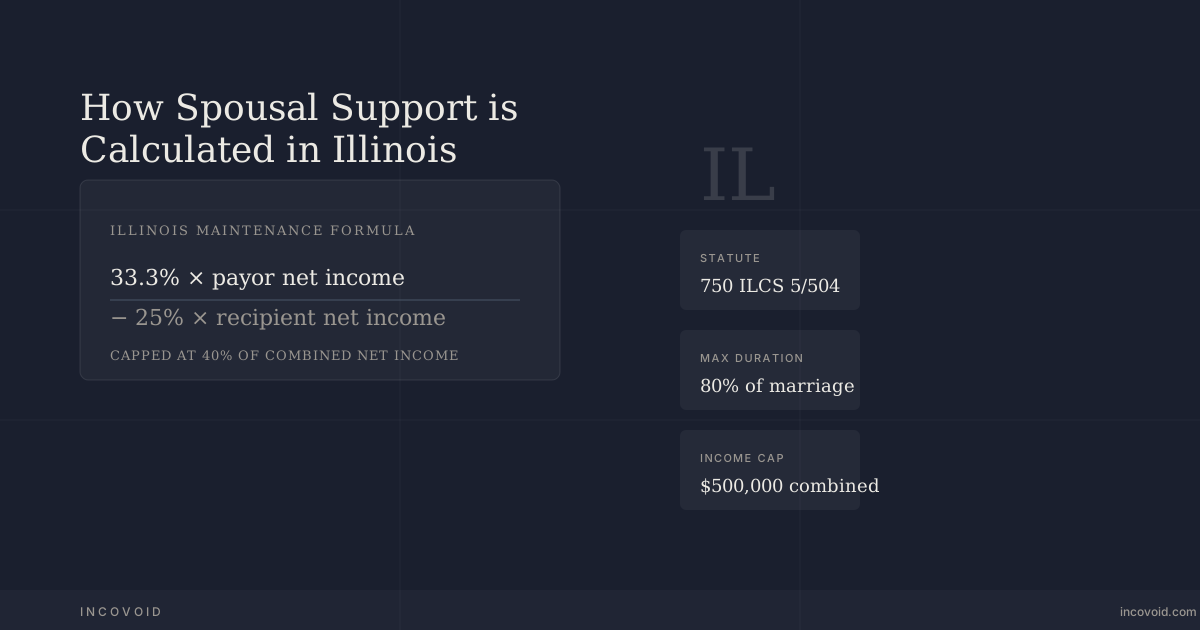
Illinois Marriage and Dissolution of Marriage Act (750 ILCS 5/504) establishes a guideline formula for couples with a combined gross income under $500,000. The formula is:
33.33% of the payer's net income minus 25% of the recipient's net income
The result cannot exceed 40% of the combined net income of both parties. This cap prevents maintenance from pushing the recipient's total income above a certain threshold relative to the household.
Here is a straightforward example:
- Payer earns $130,000/year gross (approximately $7,800/month net after taxes)
- Recipient earns $45,000/year gross (approximately $3,000/month net after taxes)
Step 1: 33.33% x $7,800 = $2,600/month
Step 2: 25% x $3,000 = $750/month
Guideline maintenance: $2,600 - $750 = $1,850/month
Check the cap: 40% x ($7,800 + $3,000) = $4,320/month. The $1,850 result falls well below this cap, so it stands.
Duration Guidelines
Illinois also provides guidelines for how long maintenance should last, based on the length of the marriage. The duration is calculated as a percentage of the marriage length:
| Marriage Length | Duration Multiplier | |---|---| | Under 5 years | 20% of marriage length | | 5 to 6 years | 24% | | 6 to 7 years | 28% | | 7 to 8 years | 32% | | 8 to 9 years | 36% | | 9 to 10 years | 40% | | 10 to 11 years | 44% | | 11 to 12 years | 48% | | 12 to 13 years | 52% | | 13 to 14 years | 56% | | 14 to 15 years | 60% | | 15 to 16 years | 64% | | 16 to 17 years | 68% | | 17 to 18 years | 72% | | 18 to 19 years | 76% | | 19 to 20 years | 80% | | 20 or more years | Permanent or equal to length of marriage |
For a 12-year marriage, the multiplier is 52%, giving a guideline duration of about 6.2 years. For a 20-year marriage, the court can award maintenance equal to the length of the marriage or permanent maintenance.
What Adjusts the Formula
These guidelines apply when the combined income is under $500,000 per year. When combined income exceeds that threshold, the court has full discretion on both the amount and duration.
Even within the guidelines, courts can deviate based on:
- Tax consequences of the maintenance award
- Significant impairment of earning capacity due to domestic responsibilities
- Standard of living established during the marriage
- Age and health of both parties
- Property awarded in the divorce
- Contribution to education or career of the other spouse
- Valid prenuptial or postnuptial agreements
If the court deviates from the guidelines, it must state its reasons in writing.
Modifications and Termination
Illinois maintenance is modifiable if there is a substantial change in circumstances, unless the parties agreed to make it non-modifiable in writing.
Maintenance automatically terminates when:
- The agreed or court-ordered end date arrives
- The recipient remarries
- Either party dies
- A court finds the recipient is cohabiting with another person on a resident, continuing conjugal basis
The cohabitation provision is meaningful. If the recipient moves in with a new partner in a relationship that functions like a marriage, the paying spouse can petition to terminate maintenance.
The $500,000 Income Cap
When combined gross income exceeds $500,000, the formula does not apply automatically. The court looks at all the same factors but has much broader discretion. High-income divorces in Illinois frequently involve negotiated settlements rather than formula results, because the statutory guidelines stop providing clear answers.
Equitable Distribution of Property
Illinois is an equitable distribution state. Property is divided fairly, but that does not mean equally. Courts consider contributions to the marriage, length of the marriage, the economic circumstances of each spouse, and the effect of custody arrangements.
The property division and the maintenance award are connected. A spouse who receives a larger share of assets may receive lower or shorter maintenance. Courts look at the full financial picture, not each issue in isolation.
Want to See Your Illinois Estimate?
Your maintenance amount depends on your specific net incomes, the length of your marriage, and whether your combined income falls under the $500,000 threshold.
IncoVoid calculates your personalized Illinois maintenance estimate using the statutory formula, including duration based on your marriage length, and flags whether your income level puts you inside or outside the guideline range.
Start your free IncoVoid assessment →
The assessment takes 12–18 minutes. Your report shows the full formula calculation with your numbers, the duration estimate, and the methodology behind both figures.
Want to see your personalized settlement estimates?
IncoVoid calculates your spousal support, property division, and career impact using your state's specific formulas. Takes 12–18 minutes.
Start free assessment →$299 · 14 pages · Your state's laws