What is Equitable Distribution in Divorce?
Equitable distribution doesn't mean equal. Here's what it actually means for your assets, and which states use it.
By IncoVoid Editorial Team
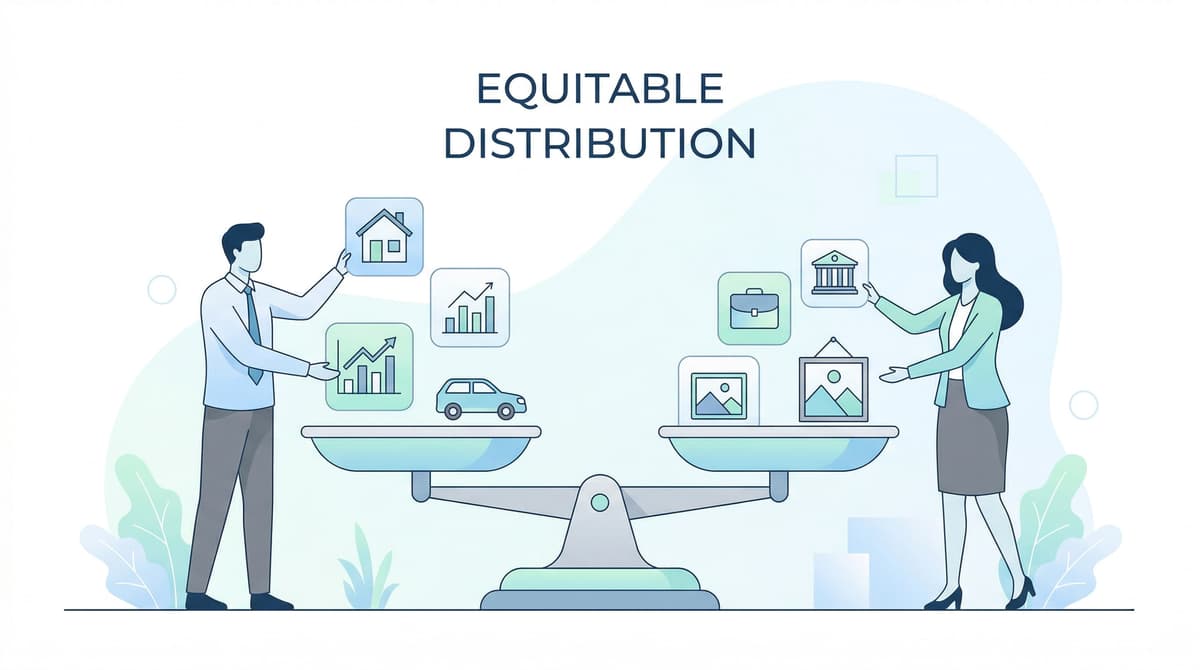
When people first hear "equitable distribution," many assume it means their marital assets will be split 50/50. That's a very common misconception, and it can lead to real surprises at the negotiating table.
Equitable means fair, not equal. And what a court considers fair depends on a detailed look at your specific situation.
Two Systems: Community Property vs. Equitable Distribution
In the United States, every state uses one of two frameworks for dividing marital property.
Community property states treat most assets acquired during the marriage as owned equally by both spouses, a true 50/50 split. There are nine community property states: Arizona, California, Idaho, Louisiana, Nevada, New Mexico, Texas, Washington, and Wisconsin.
Equitable distribution states, which make up the majority of states, take a more flexible approach. A judge weighs multiple factors and divides assets in whatever proportion they find fair. The split could be 50/50, but it could also be 60/40, 70/30, or something else entirely depending on the circumstances.
If you're in an equitable distribution state, don't assume you'll walk away with half of everything. And don't assume you'll walk away with less than half, either.
What Factors Courts Consider
Every equitable distribution state has its own statute, but the factors they weigh are broadly similar:
Length of the marriage. A 20-year marriage is treated very differently from a 2-year one. Longer marriages tend toward more equal splits because the financial lives of both spouses have become deeply intertwined.
Income and earning capacity. If one spouse earns significantly more, or has much higher earning potential, courts often adjust the split to compensate.
Career sacrifice. This one is huge and often overlooked. If one spouse stepped back from their career to raise children or support the other's career advancement, courts recognize that this sacrifice has real financial value. The spouse who stayed home built the other's career equity at the cost of their own.
Contributions to the marriage. This includes non-financial contributions. Taking care of the home, raising children, supporting a spouse through school: courts see these as real economic contributions.
Standard of living. Courts aim to help both spouses maintain a reasonable standard of living, especially if there's a large income gap.
Custody of children. The spouse who has primary custody of the children often has a stronger claim to the family home, at least in the short term, to minimize disruption for the children.
Age and health. An older spouse or one with a serious health condition may receive a larger share because their ability to rebuild financial security is more limited.
Debts. Equitable distribution applies to liabilities, not just assets. Who is responsible for which debts gets divided too.
Common Misconceptions
"50/50 is the default." In most equitable distribution states, there's no legal presumption of equal division. Judges have wide discretion.
"What I earned is mine." Income earned during the marriage is typically marital property, regardless of whose paycheck it came from. Your spouse may have a claim to a portion of your retirement savings, your business equity, and your stock options, even if they were in your name alone.
"The house will obviously go to the person who paid the mortgage." Not necessarily. The mortgage payments came from marital income. Who keeps the house depends on a lot more than who wrote the checks.
"I can protect assets by putting them in my name only." Titling doesn't determine marital property status in most equitable distribution states. If it was acquired during the marriage with marital funds, it's likely marital property.
How Separate Property Is Protected
Separate property is generally not subject to equitable distribution. This typically includes:
- Assets you owned before the marriage
- Inheritances (even if received during the marriage)
- Gifts given specifically to you (not to both of you as a couple)
The key is keeping separate property clearly separate. If you deposit an inheritance into a joint account and it gets mixed with marital funds, it can become "commingled," and you may lose the separate property protection.
The appreciation of separate property during the marriage can get complicated. If you owned a rental property before marriage and it doubled in value during the marriage, some (or all) of that appreciation may be considered marital in some states.
Negotiated Settlements vs. Court Orders
Most divorcing couples don't actually go to court for a judge to decide. Around 95% of divorces settle through negotiation, mediation, or collaborative divorce processes.
This is important: if you and your spouse can agree on how to divide your assets, the court will generally approve it as long as it's not wildly unfair. You have real flexibility to structure a deal that makes sense for your situation, and knowing your numbers before you negotiate matters so much.
Want to See What Your Division Might Look Like?
Knowing which assets are marital vs. separate, how your state weighs the relevant factors, and what a reasonable division range looks like: that's the foundation of any negotiation.
IncoVoid runs your property division calculation using your state's specific framework and shows you an estimated range for your share of marital assets.
Start your free IncoVoid assessment →
Understanding your likely range before you sit down, whether with your spouse, a mediator, or an attorney, puts you in a fundamentally stronger position.
Want to see your personalized settlement estimates?
IncoVoid calculates your spousal support, property division, and career impact using your state's specific formulas. Takes 12–18 minutes.
Start free assessment →$299 · 14 pages · Your state's laws